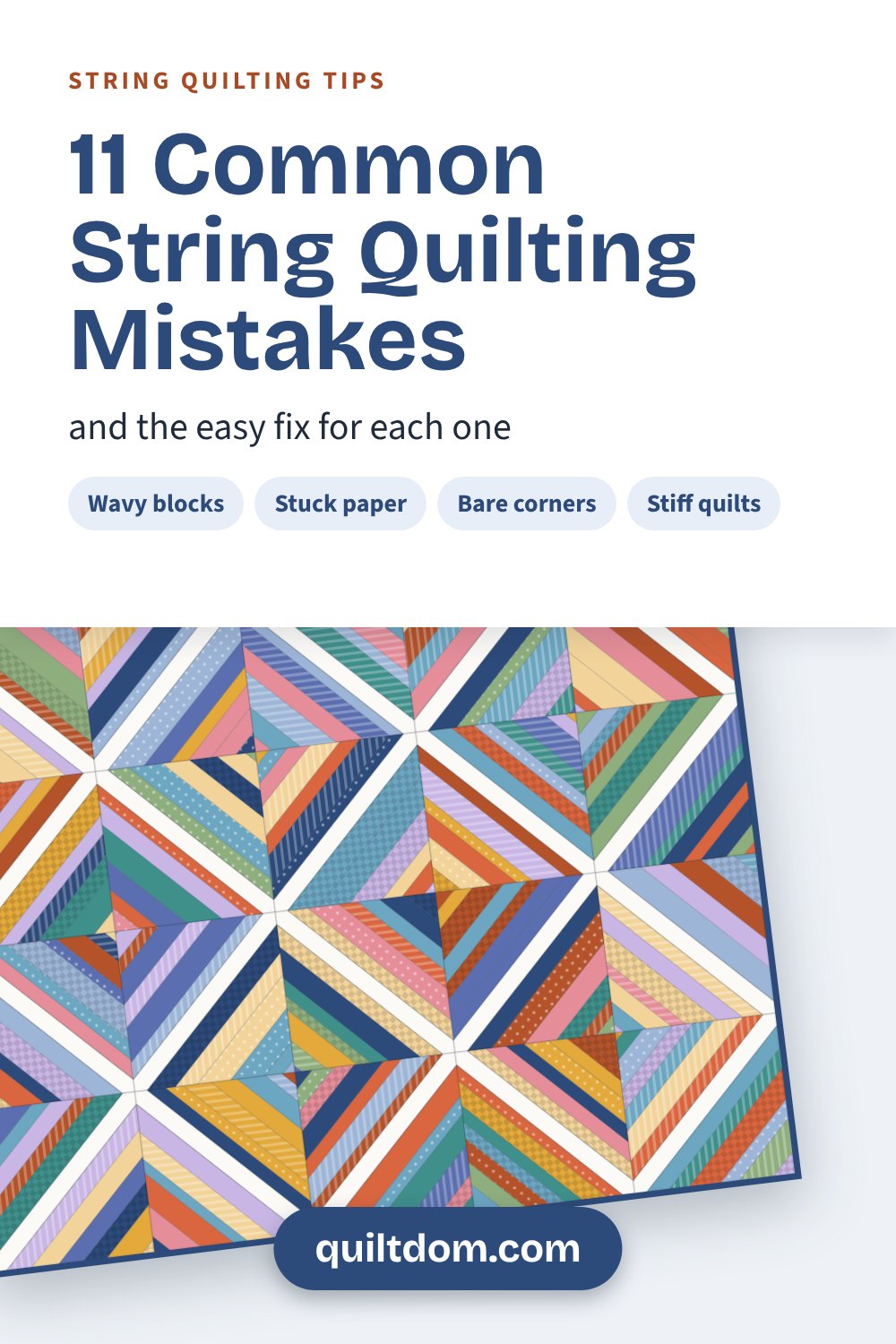
String quilts are one of the most forgiving quilts you can make. Wonky strips, mismatched prints and odd little scraps all have a home in a string quilt.
But forgiving doesn't mean foolproof.
A few small missteps can leave you with wavy blocks, paper that won't budge, or a quilt that feels more like a stiff board than a cozy blanket.
We will walk through the 11 most common string quilting mistakes and show you exactly how to fix each one, so your next scrappy quilt comes together smoothly.
What’s In This Post:
- 1. Skipping the Foundation
- 2. Using Your Normal Stitch Length on Paper
- 3. Cutting Your Strings Too Narrow
- 4. Forgetting the Center Strip
- 5. Strings That Don't Reach the Edges
- 6. Skipping the Pressing
- 7. Trimming from the Front
- 8. Removing the Paper Too Early
- 9. Mismatched Center Strips
- 10. Letting Every Scrap Fight for Attention
- 11. Ending Up with a Heavy, Stiff Quilt
- Ready to Start Your String Quilt?
1. Skipping the Foundation
Strings are often narrow and cut every which way, so many of them end up on the bias. Sew them together without a foundation and they will stretch, ripple and refuse to lie flat.
The fix: Always sew your strings onto a foundation. Lightweight paper, muslin or a thin solid cotton all work. If you're new to the technique, our string quilt tutorial walks you through the whole process step by step.
2. Using Your Normal Stitch Length on Paper
If you piece on paper with your usual 2.5 mm stitch, you will spend hours picking tiny bits of paper out of your seams.
The fix: Shorten your stitch to about 1.5 to 1.8 mm. Those tiny stitches perforate the paper like a postage stamp, so it tears away cleanly. A 90/14 needle helps too. On a fabric foundation, your regular stitch length is fine.
3. Cutting Your Strings Too Narrow
A ¼" seam on each side eats ½" of every string. That means a ¾" scrap leaves you with a skinny ¼" sliver that looks like a pinstripe and adds bulk.
The fix: Keep most of your strings between 1" and 2½" wide. Mixing widths in that range gives you the classic string look without the bulk.
4. Forgetting the Center Strip
Without a consistent center strip, every block looks random, and the finished quilt has nowhere for your eye to rest.
The fix: Start every block with the same center strip, placed corner to corner on the diagonal. A solid white, black or one favorite color works best. When you join the blocks, those strips form diamonds or X's that tie all your scraps together.
TIP: Cut all of your center strips at once from the same fabric so they are exactly the same width.
5. Strings That Don't Reach the Edges
There is nothing more frustrating than finishing a block and finding a bare corner of foundation peeking out.
The fix: Before you sew, flip each string into place and make sure it extends at least ¼" past the foundation on both ends. The corner strings are the shortest, so save your little leftover pieces for those.
6. Skipping the Pressing
Sewing string after string without pressing creates tiny pleats along every seam. By the last string, your block can end up noticeably smaller than the foundation.
The fix: Press each string flat before you add the next one. A quick press with a dry iron works great, and a wooden seam roller is a handy shortcut for the middle strings.
7. Trimming from the Front
Trimming from the right side means guessing where the block ends, and those guesses add up to blocks that are all slightly different sizes.
The fix: Flip the block over and trim from the back, using the edge of the foundation as your guide. Then check every block with a square ruler. Our guide to squaring a quilt has more tips for keeping everything straight.
8. Removing the Paper Too Early
Once the paper comes off, all those bias edges are free to stretch again.
The fix: Leave the paper in until your blocks are sewn into rows or the whole top is together. Some quilters also stitch ⅛" around the edge of each block first to keep the seams from popping open. When it's time, fold the paper along each seam line and tear gently.
9. Mismatched Center Strips
String quilts get their wow factor from the center strips lining up into a pattern. When they miss by even ¼", the whole design looks a little off.
The fix: Lay out all of your blocks first and decide how you will rotate them. When you sew the blocks together, pin right where the center strips meet before you stitch the seam.
10. Letting Every Scrap Fight for Attention
It's tempting to toss in every scrap you own. But when every strip is a loud print in the same medium value, the blocks turn into mud.
The fix: Sort your fabric scraps by value before you start. Mix lights, mediums and darks in each block, and add a few calm solids or tone-on-tone prints so your favorite busy prints have room to shine.
11. Ending Up with a Heavy, Stiff Quilt
A fabric foundation adds an extra layer under every block. Add thick batting and dense quilting, and your string quilt can feel like cardboard.
The fix: Use a lightweight foundation such as thin muslin, or use paper and remove it. Then choose a low-loft batting and an open quilting design. Simple diagonal lines or a loose meander keep the quilt soft and drapey.
Ready to Start Your String Quilt?
Every one of these mistakes is easy to avoid once you know what to look for. And if a block turns out a little wonky anyway, that is part of the charm of a scrappy quilt.
If you need some inspiration for your next project, check out our roundup of string quilt patterns and start turning that scrap bin into something beautiful.