
Before the rotary cutter, quilters spent hours cutting every piece of fabric with scissors. Originally invented for the garment industry, the rotary cutter became a staple on quilters' cutting tables in the 1980s, and it changed quilting overnight. Cutting that once took days now takes minutes, with far more accuracy.
But with so many sizes and styles to choose from, which rotary cutter should you buy? Below, you'll find our 6 favorite rotary cutters for quilting, a quick comparison, how to choose the right blade size and handle, and tips for using your cutter safely.
Best Rotary Cutters at a Glance
| Rotary cutter | Blade | Best for |
|---|---|---|
| Fiskars Ergo Control | 45mm | Everyday quilting and beginners |
| Fiskars Titanium Comfort Loop | 60mm | Thick layers and batting |
| Olfa Deluxe Handle | 45mm | Automatic safety guard |
| Olfa Deluxe | 60mm | Big jobs, rag quilts and wool |
| Martelli Ergo 2000 | 45mm | Arthritis or wrist pain |
| Olfa Straight Handle | 28mm | Small pieces and curves |
The 6 Best Rotary Cutters for Quilting
1. Fiskars 45mm Ergo Control Rotary Cutter
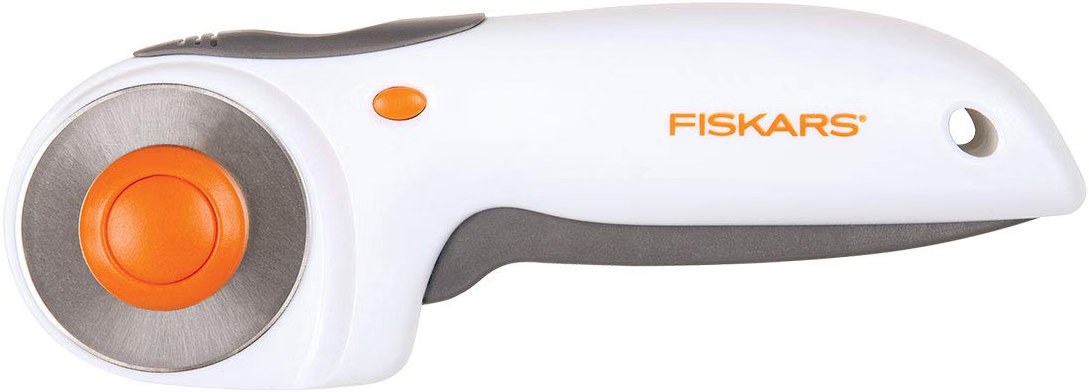
Best for: everyday quilting and beginners
This all-purpose cutter from Fiskars has a 45mm premium steel blade that cuts smoothly through multiple layers of fabric. The sculpted handle is longer than most, which gives you better control and reduces hand fatigue during long cutting sessions.
The blade design gives both left- and right-handed quilters a clear view of the cutting line. For safety, the blade guard extends automatically when you release the handle, so the blade is covered every time you set the cutter down. It also comes with a lifetime warranty.
2. Fiskars 60mm Titanium Softgrip Comfort Loop Rotary Cutter

Best for: thick layers, batting and squaring up quilts
This cutter handles 6 or more layers of fabric. The loop handle gives you excellent control, and the blade can be set up for right- or left-handed use.
Its long-lasting titanium-coated blade cuts through batting and layered quilts with ease, which makes it a great choice for trimming a finished quilt sandwich.
3. Olfa 45mm Deluxe Handle Rotary Cutter

Best for: quilters who want an automatic safety guard
This classic Olfa cuts up to six layers of fabric easily and works well for most quilting tasks. The contoured rubber grip has a squeeze trigger, so the blade is only exposed while you squeeze and retracts on its own when you let go.
A red button locks the blade open for longer cutting sessions. The blade can be moved to either side for left- or right-handed use, and the cutter also accepts a pinking blade for fray-resistant edges.
4. Olfa Deluxe Rotary Cutter (60mm)

Best for: big cutting jobs, rag quilts and wool
For large projects, this cutter slices through up to 8 layers of fabric at once. Like its 45mm sibling, it has a squeeze-trigger handle that retracts the blade automatically.
The large blade cuts through layers of batting and fabric, so it is especially useful for rag quilts and wool projects. It also handles thin foam for tote bags and quilted purses. Avoid foam that is thicker than the blade is wide.
5. Martelli Ergo 2000 45mm Rotary Cutter

Best for: quilters with arthritis or wrist pain
The Martelli is shaped so your hand sits in a natural position, with pressure spread across your arm and palm instead of your wrist. That alignment adds cutting power, so you can cut up to 15 layers of fabric.
It uses any standard 45mm blade, and the spring-loaded guard closes with a flick of a finger. The blade does not switch sides, so buy the right- or left-handed version to match your cutting hand. Martelli also has a helpful video on using the guard and changing the blade.
6. Olfa 28mm Straight Handle Rotary Cutter (RTY-1/G)

Best for: small pieces, curves and applique
This small cutter is a great companion to your main rotary cutter. Its 28mm blade moves smoothly around curves, which makes it ideal for small pieces, applique shapes and trimming.
Push the tab forward to expose the blade and pull it back to retract. The blade switches sides for right- or left-handed use. Because the mechanism is so simple, keep it well out of reach of children.
How to Choose a Rotary Cutter
Blade size
- 18mm: tiny pieces, miniatures and tight curves.
- 28mm: small pieces, curves, applique and trimming.
- 45mm: the all-purpose size most quilters use every day. If you only buy one cutter, buy a 45mm.
- 60mm: many layers at once, batting and thick fabrics like flannel, denim and wool.
Handle style
- Straight handles are simple and compact, and they're common on smaller cutters.
- Contoured and loop handles fill your hand and give you more control during long cutting sessions.
- Ergonomic handles like the Martelli keep your wrist straight, which helps if you have arthritis or carpal tunnel.
Safety features
Some cutters have a blade guard you open and close by hand, while others retract automatically when you stop squeezing. Automatic guards are a great choice for beginners and for homes with children.
Left- or right-handed use
Most cutters let you move the blade to either side. A few ergonomic models, like the Martelli, come in separate right- and left-handed versions.
Replacement blades
Blades wear out, so check that replacements are easy to find. Standard 45mm and 60mm blades are widely available, and many fit cutters from other brands.
How to Use a Rotary Cutter
- Always cut on a self-healing mat. A self-healing cutting mat protects your table and your blade.
- Use a quilting ruler as your guide. Hold it firmly with your fingers spread and away from the edge.
- Keep the blade against the ruler and tilt the cutter slightly toward it.
- Cut away from your body in one smooth push, using your shoulder rather than your wrist.
- Close the blade immediately every time you put the cutter down.
Tips for Using a Rotary Cutter
- Never cut paper or interfacing with your fabric cutter. It dulls the blade.
- Keep pins away from the cutting line. Hitting a pin nicks the blade, and a nicked blade skips threads.
- Don't saw back and forth. It roughens the edge and loosens the threads. Push forward in one smooth motion instead.
- Dispose of old blades safely. Old blades are still razor sharp. Fold an index card in half, tape the sides, slip the blade inside and tape it shut before you throw it away.
- Store your cutter out of reach of children. Kids figure out how to open the blade surprisingly quickly.
- Keep bandages near your cutting area just in case.
When Should You Replace a Rotary Blade?
Change your blade when you notice any of these signs:
- It skips threads or leaves uncut spots along the line.
- You have to press harder or go over a cut twice.
- The edges of your cuts look ragged.
- You can see a nick in the blade.
How often depends on how much you cut, but many quilters start each big project with a fresh blade.
Rotary Cutter FAQs
What size rotary cutter is best for beginners?
A 45mm cutter. It handles almost every quilting task and is the easiest size to find blades for.
Do I need a cutting mat to use a rotary cutter?
Yes. Cutting on a table or a regular board ruins the blade and your work surface. A self-healing mat closes up after each cut.
Can I use any brand's blades in my cutter?
Many blades are interchangeable as long as the size matches, and the Martelli accepts any 45mm blade. Check your cutter's instructions to be sure.
Are rotary cutters safe?
They are very safe when used correctly. Always cut away from your body, keep your fingers clear of the blade path and close the blade every time you set it down.
Final Thoughts
A good, reliable rotary cutter is one of the most important tools in your sewing room.
Our two favorites are the Fiskars Ergo Control and the Martelli. The Fiskars cuts through multiple layers, and its blade guard covers the blade automatically whenever you let go of the handle. The Martelli powers through layer upon layer of flannel, and its ergonomic design is a lifesaver for quilters with carpal tunnel syndrome or similar conditions.
Pair your new cutter with a good mat and ruler, and you'll be cutting faster and more accurately than ever. Next, check out our picks for the best self-healing cutting mats and quilting ironing boards.